For the discerning traveller traversing the undulating landscapes of the Ribble Valley, a recurring debate inevitably surfaces: which of its stone-hewn settlements truly claims the title of the “nicest” village?
As an Area of Outstanding Natural Beauty (AONB) defined by the dramatic millstone grit of Pendle Hill and the meandering silver of the River Ribble, the competition is formidable.
However, when one filters for architectural purity, historical preservation, and an atmosphere untainted by the frantic pulse of the twenty-first century, a clear hierarchy emerges.
The Peerless Champion: Downham
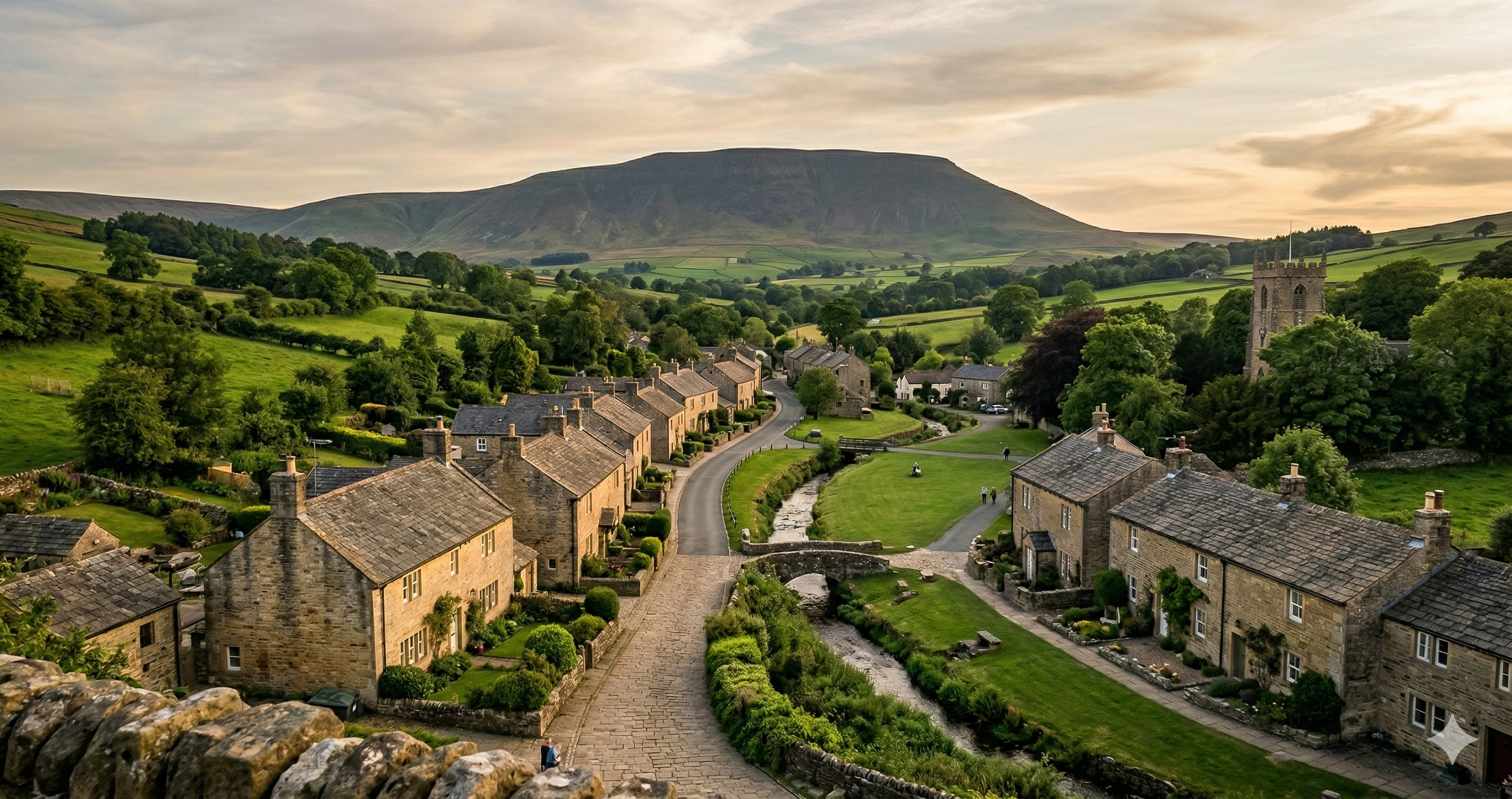
To enter Downham is to step across an invisible threshold into a bygone era.
Under the ancestral stewardship of the Assheton family, the village has famosly eschewed the visual “clutter” that plagues modern rural England.
There are no overhead power lines stitching the sky, no satellite dishes clinging to gable ends, and a refreshing absence of garish road signage.
The Tangible Experience
The village follows a gentle incline, its cottages constructed from local limestone that glows with a muted gold in the late afternoon sun.
A crystalline beck bisects the lower village, its soft babble providing the primary soundtrack to your visit.
- The Vesper View: Ascend the lane toward St Leonard’s Church. From the elevated churchyard, the view is peerless: the 15th-century tower stands in stark relief against the brooding, velvet-clad slopes of Pendle Hill. This is the quintessential Ribble Valley vista—rugged, ancient, and profoundly still.
- The Cinematic Connection: Its aesthetic perfection is so absolute that it served as the primary filming location for the 1961 classic Whistle Down the Wind. Even sixty years later, the village remains physically unchanged.
- Culinary Grounding: The Assheton Arms acts as the village’s epicurean anchor. It successfully straddles the line between a sophisticated gastro-pub and a traditional hostelry. For an authentic experience, request a table in the rear conservatory to watch the shadows lengthen across the valley floor while sampling the local seasonal game.
The Close Contenders: A Study in Character
While Downham secures the top spot for its sheer preservation, several other villages offer compelling, albeit slightly different, charms that make them essential stops on any itinerary.
1. Waddington: The Epicurean Heart
Often the victor in “Best Kept Village” competitions, Waddington is the Ribble Valley’s most vibrant floral masterpiece.
- The Feature: The village is defined by the Coronation Gardens, a meticulously manicured public space where the bubbling brook is framed by an explosion of seasonal blooms.
- The Social Fabric: Unlike the monastic quiet of Downham, Waddington pulses with social energy. With a trio of exceptional establishments—The Higher Buck, The Waddington Arms, and The Lower Buck—it is arguably the finest destination in the North of England for a “pub crawl” defined by high-end viticulture and refined British cuisine.
- The Verdict: It misses the top spot only because it feels “curated” rather than “ancient.” It is a village of immaculate presentation rather than raw historical gravity.
2. Hurst Green: The Literary Muse
Situated in the shadow of the monumental Stonyhurst College, Hurst Green possesses an air of scholarly mystery and rugged, Tolkien-esque allure.
- The Tolkien Trail: J.R.R. Tolkien frequently stayed at the college, and it is widely accepted that the surrounding woods and the Hacking Ferry served as the topographical inspiration for the Shire. Walking the 5.5-mile circular trail from the village allows you to walk through the very landscapes that birthed Middle-earth.
- Architectural Weight: The village is dotted with 17th-century almshouses and the grand Shireburn arms, providing a sense of weight and permanence.
- The Verdict: While the surrounding scenery is perhaps the most dramatic in the valley, the village layout itself is somewhat fragmented, lacking the cohesive “central green” intimacy found in Downham.
3. Ribchester: The Roman Bastion
Ribchester offers a different texture entirely, trading idyllic cottages for deep, archaeological significance as the site of the Roman fort, Bremetennacum.
- The Living History: The Ribchester Roman Museum is a jewel of the North, housing artifacts that tell a story of 2,000 years of continuous habitation.
- Riverside Access: Behind the Ribchester Arms, the River Ribble widens into a serene stretch perfect for riverside contemplation or a shallow summer paddle.
- The Verdict: Ribchester is a fascinating historical destination, but as a “village,” its aesthetic is more eclectic and less uniformly “quaint” than its neighbors.
The Definitive Verdict
For the visitor seeking the “nicest” village—one that captures the ethereal, untouched soul of Lancashire—Downham remains the undisputed sovereign.
It is a rare triumph of preservation over modernization.
However, if your definition of “nicest” includes a bustling social scene and a world-class Sunday roast, Waddington is a very close second.