If you’re visiting Clitheroe for the first time, this is a simple way to spend your time:
- Start at Clitheroe Castle and Castle Grounds
- Walk down into the town centre and explore the shops
- Stop for coffee or lunch
- Visit Holmes Mill or a local pub
- Finish with food or drinks in the evening
Best Things to Do in Clitheroe
Clitheroe Castle & Grounds
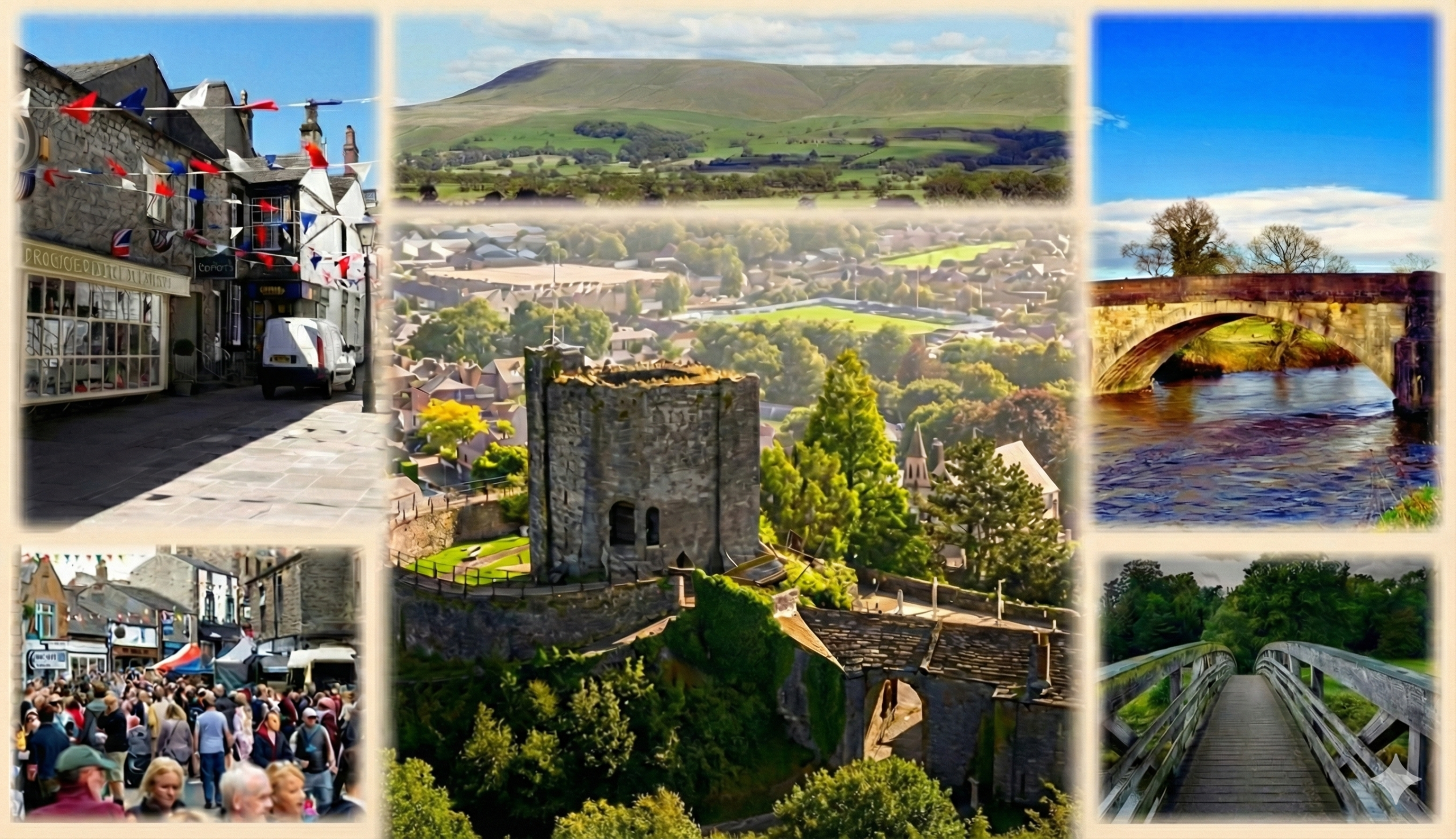
The main landmark in the town, Clitheroe Castle sits on a hill overlooking the area and has dominated the skyline for over 800 years.
The grounds are free to explore and are one of the best viewpoints in the Ribble Valley.
Clitheroe Market
Held regularly in the town centre, the market has been part of Clitheroe life for centuries and is still a great place to browse local produce and independent stalls.
Holmes Mill
One of the standout spots in Clitheroe, Holmes Mill combines food, drink and entertainment in one place.
It’s home to a beer hall, food hall and cinema, making it worth visiting even if you’re just passing through.
Town Centre & Independent Shops
Clitheroe is known for its independent shops, food stores and wine merchants, giving it a much stronger identity than many similar towns.
Take time to wander — this is where the town really stands out.
Where to Eat in Clitheroe
Clitheroe is often described as the food capital of the Ribble Valley, with a wide range of restaurants, cafés and pubs.
If you want something casual:
- Cafés and lunch spots in the town centre
If you want a proper meal:
- Book ahead, especially at weekends
- Many restaurants focus on local produce
If you want something different:
- Head to Holmes Mill for a mix of options
👉 See the best restaurants in Ribble Valley
👉 Find cafés in Ribble Valley
👉 Explore pubs in Ribble Valley
Walks from Clitheroe
Clitheroe is a great base for walking, with easy access to both short routes and longer countryside walks.
Easy option:
- Walk around the castle and surrounding park
Nearby highlights:
- Pendle Hill (short drive)
- Forest of Bowland
- Riverside walks
Clitheroe: The Stone Heart and Soul of the Ribble Valley
Clitheroe is compact enough to explore on foot, but has enough going on to easily fill a full day.
To truly understand Clitheroe, you have to look at the stone that built it—both the stone that pushed up to create it, and the stone humans shaped to govern it.
The visual pulse of this historic market town is the dramatic, jagged limestone crag that dominates the entire valley skyline. It is the reason Clitheroe exists.
Millennia ago, it offered a commanding defensive position, and over the centuries, it shaped the local economy. Today, it still shapes the town’s atmospheric character.
Clitheroe isn’t just a location on a map; it is a layered experience where an industrial heartbeat now thrums inside 800-year-old stone, and ancient feudalism rubs shoulders with some of Lancashire’s best contemporary shopping.
This isn’t a passive heritage trail; it’s a living, breathing community built on a very solid foundation.
The Deep Roots: A History Cut from the Limestone
The philosophical core of Clitheroe is one of resilience and commerce.
While the settlement likely predates the Norman Conquest, its recorded story begins with the castle keep, built around 1186 by Robert de Lacy.
This small but significant keep—reputedly one of the smallest surviving keeps in England—is the definitive “stone heart” of the valley.
For the potential visitor, the physical layout of the town tells this historical story perfectly.
As you stand in the market square (still held every Tuesday, Thursday, and Saturday), you can trace the development of Clitheroe outward. The market itself is the town’s original economic driver, charter-born from the power of the castle.
Clitheroe escaped the extensive textile mill dominance seen further south in the Lancashire cotton towns; here, the “industry” was more varied, focusing on quarrying (the limestone again) and being the primary trading hub for the entire Ribble Valley agriculture belt.
This diverse economic base allowed the town to maintain its independant character, which you still feel intensely on its streets.
The Modern Pulse: More than Just Heritage
The greatest asset of modern Clitheroe is that it hasn’t become a museum piece. Instead, it has taken its historic spaces and reimagined them.
The most tangible example of this is Holmes Mill. Historically, this was one of the town’s significant textile mills, but it has been transformed into a massive leisure complex.
It’s now the sensory hub of the town—it houses one of the longest bars in Britain (a beer hall showcasing hundreds of local ales), a large food hall highlighting local producers, a brewery, and even a cinema.
Holmes Mill is where Clitheroe’s industrial soul now serves as a canvas for a modern culinary destination.
As you leave the mill and walk up Castle Street, you see the independant shops.
Clitheroe is a “high street destination” precisely because it has resisted the creeping homogeneity of chain stores.
- For the “Foodie”: The steep hill is lined with exceptional specialists. Look for Cowman’s Famous Sausage Shop (offering hundreds of locally-made varieties—a must-visit since 1904) and the renowned Byrne’s Wine Shop, which is a cavern of international finds housed in another historic stone building.
- For the Explorer: The independent spirit extends to bookshops, quality clothing boutiques, and art galleries, making a day of wandering intensely practical and rewarding.
A Visitor’s Practicalities: Your On-the-Ground Guide
To get the most out of Clitheroe, blend the practical with the philosophical.
- The Ascent of the Castle Keep: Start your visit by climbing the crag. Don’t just tick it off a list; experience the view. Stand at the keep and let your eyes follow the ancient line of the Ribble Valley. The history becomes tangible as you look toward Pendle Hill (famed for its witch trials) and realise that this stone tower was the pivot for centuries of valley life. The surrounding museum and labyrinth are fantastic for practical historical context.
- Parking: The primary visitor parking is the Chester Avenue Car Park (large, centrally located, and multi-stay).
- Walking Difficulty: Castle Street is steep. For visitors with mobility issues, you may want to park in Chester Avenue and explore that flatter middle-section first. Alternatively, the lower part of town near Holmes Mill is much flatter.
- The Best Light: For the perfect photo of the Castle on its crag, the early afternoon often provides the best light from the west, casting dramatic shadows. For atmosphere, visiting Holmes Mill in the late afternoon when the beer hall is beginning to bustle offers the true sensory pulse of the modern town.
- Connecting Your Visit: Clitheroe connects wonderfully to neighbouring Whalley (just 10 minutes away) or Longridge (20 minutes), making it a logical and practical anchor for any larger exploration of the area.
Clitheroe, more than any other town in the region, offers a perfect fusion. It allows you to stand on 800-year-old battlements and, within minutes, be discussing locally-grown produce with a fifth-generation specialist.
It is this authentic, tangible, and grounded character that makes it the inescapable and stone-solid soul of the Ribble Valley.