
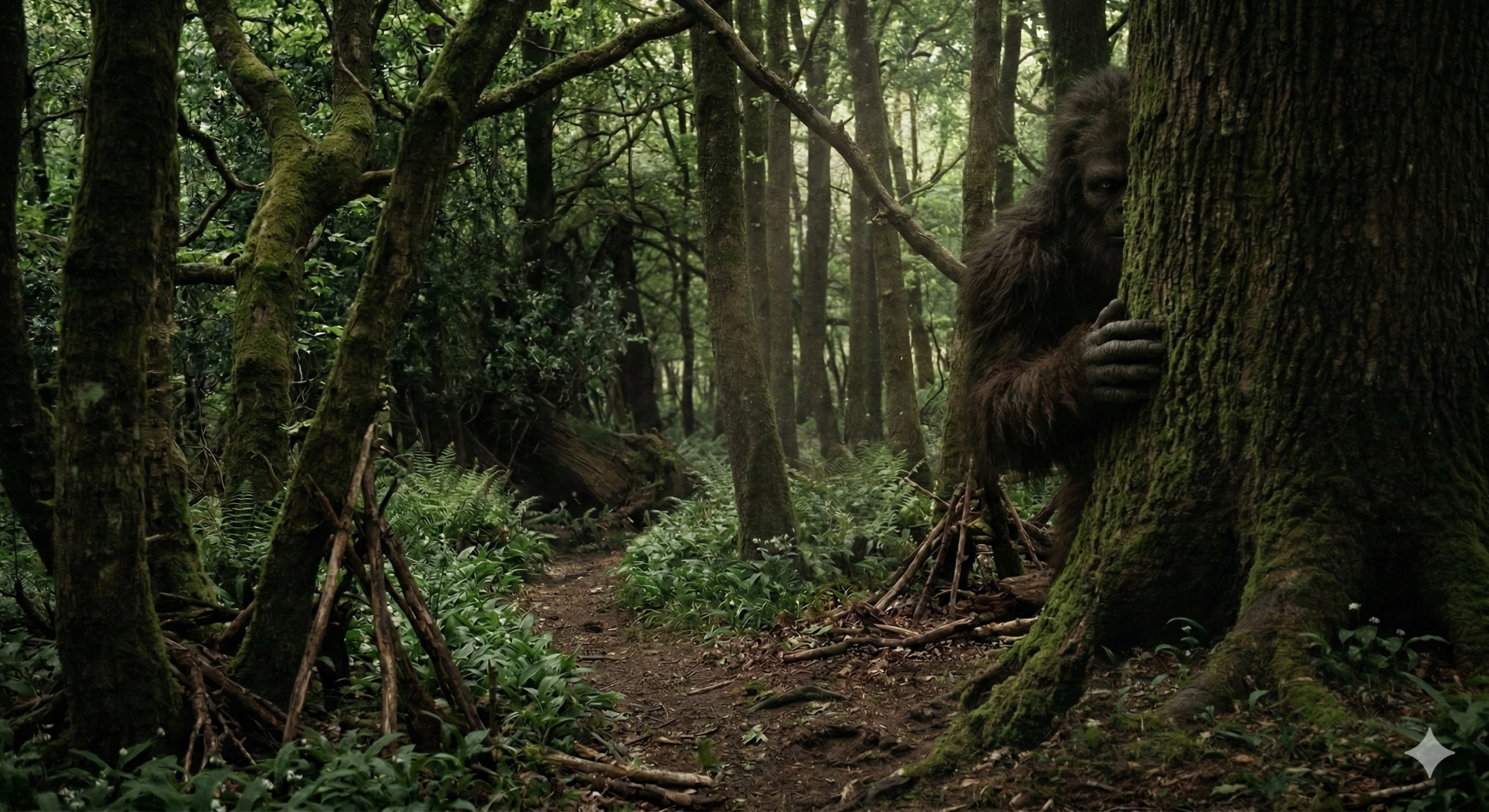
The Ribble Valley is a landscape defined by its clarity—the crisp lines of Pendle Hill, the preserved stone of Whalley Abbey, and the curated beauty of its villages.
Yet, for those who dig into the region’s darker corners, there is a persistent “shadow history.”
It is a chronicle of encounters with large, bipedal, hairy entities that locals have called by many names: The Woodwose, the Boggart, and—more recently—the British Bigfoot.
While the idea of a primate in Lancashire sounds like fiction, the “paper trail” of sightings and physical artifacts suggests a mystery that has spanned over six centuries.
1. The Medieval Evidence: The Whalley Woodwose
The most credible evidence of a “hairy-man” archetype in the valley isn’t a blurry photo—it is carved in 15th-century oak.
If you visit St Mary and All Saints Church in Whalley, you will find the famous misericords (mercy seats) salvaged from the Abbey after the Dissolution.
The Record: Specifically, Misericord N06 depicts a “Satyr” or Woodwose—the medieval European equivalent of a Bigfoot—confronting a woman.
The carving is accompanied by the chilling Middle English inscription: “Penses molt et parles pou” (Think much and speak little).
This suggests that 600 years ago, the people of the Ribble Valley were already sharing stories of powerful, hairy, human-like beings inhabiting the dense local forests.
2. The 19th-Century ‘Demon’ of Hothersall Hall
In the 1867 volume Lancashire Folklore by John Harland and T.T. Wilkinson, a strange account is preserved regarding Hothersall Hall, near Ribchester. For generations, the estate was said to be “laid under a spell” by a powerful, terrifying entity.
While modern readers might dismiss a “Boggart” as a fairy tale, 19th-century descriptions of the Hothersall entity portray it as a physical, hairy, and immensely strong “beast” that haunted the riverbanks.
The lore claims a priest eventually “laid” the creature under a laurel tree on the estate, but the description perfectly matches the “Wildman” sightings that persist in the area today.
3. The Modern Sightings: From Bowland to Witton Park
The mystery didn’t end with the Victorian era; if anything, the 21st century has seen a surge in detailed, technical reports.
- The 2015 ‘Habitation’ Report: In July 2015, researchers from the British Bigfoot Research Organization (BBRO) investigated a remote section of the Forest of Bowland. They documented a structured “bed” of dry straw located inside a sheltered, disused mine entrance, alongside “X-pattern” stick structures—signs frequently cited in North American Sasquatch research but rarely attributed to any known UK wildlife.
- The 2018 Witton Park Incident: On September 1, 2018, at Witton Country Park (on the valley’s western fringe), local bushcraft expert Oliver Haworth reported a daylight encounter. He described a 7-foot-tall, ginger-haired bipedal creature. As an experienced outdoorsman trained in tracking, Haworth noted that the creature moved with a “fluidity and speed” that no human in a suit could replicate in dense brush.
4. The Ribble Corridor: A Trail of Anomalies
The mystery extends beyond the valley floor, following the natural corridors of the fells and the river itself.
The ‘Snouted Watcher’ of the Trough
In the 1990s, a witness in the Trough of Bowland reported a chilling encounter to researcher Deborah Hatswell.
While playing in the woods, she saw a large, bipedal creature crouched behind a tree.
Interestingly, she described a “snouted” face and long, dark fur—a description that straddles the line between a traditional Woodwose and the “Dogman” phenomena reported elsewhere in the UK.
Pendle Hill: Beyond the Witches
Pendle Hill is famous for the 1612 Witch Trials, but hikers frequently report “shadowy, bipedal figures” moving at impossible speeds across the cloughs (steep valleys) on the hill’s eastern face.
These figures are described as being significantly larger than a human, darting between the mist and the peat hags with an agility that defies the treacherous terrain.
The Beast of Green Drive (2005)
Connected to the Ribble Valley via the river corridor, the Lytham area was gripped by a media frenzy in May 2005.
Over 20 residents reported a “beast” with a “lolloping gait” and large ears.
While skeptics suggested a large fox, the sheer number of simultaneous reports from independent witnesses remains one of Lancashire’s most baffling modern clusters.
Fact or Folklore?
Do these accounts prove a biological Bigfoot lives in the Ribble Valley? Scientifically, we lack the “body on the table.” But we do have historical consistency.
From the medieval woodcarver at Whalley to the 21st-century bushcraft expert at Witton Park, people in this valley have described the same entity for 600 years: a large, hairy, solitary figure that remains just out of reach.
The Ribble Valley holds its secrets well. As the ancient Whalley carving warns us: Think much, and speak little.