
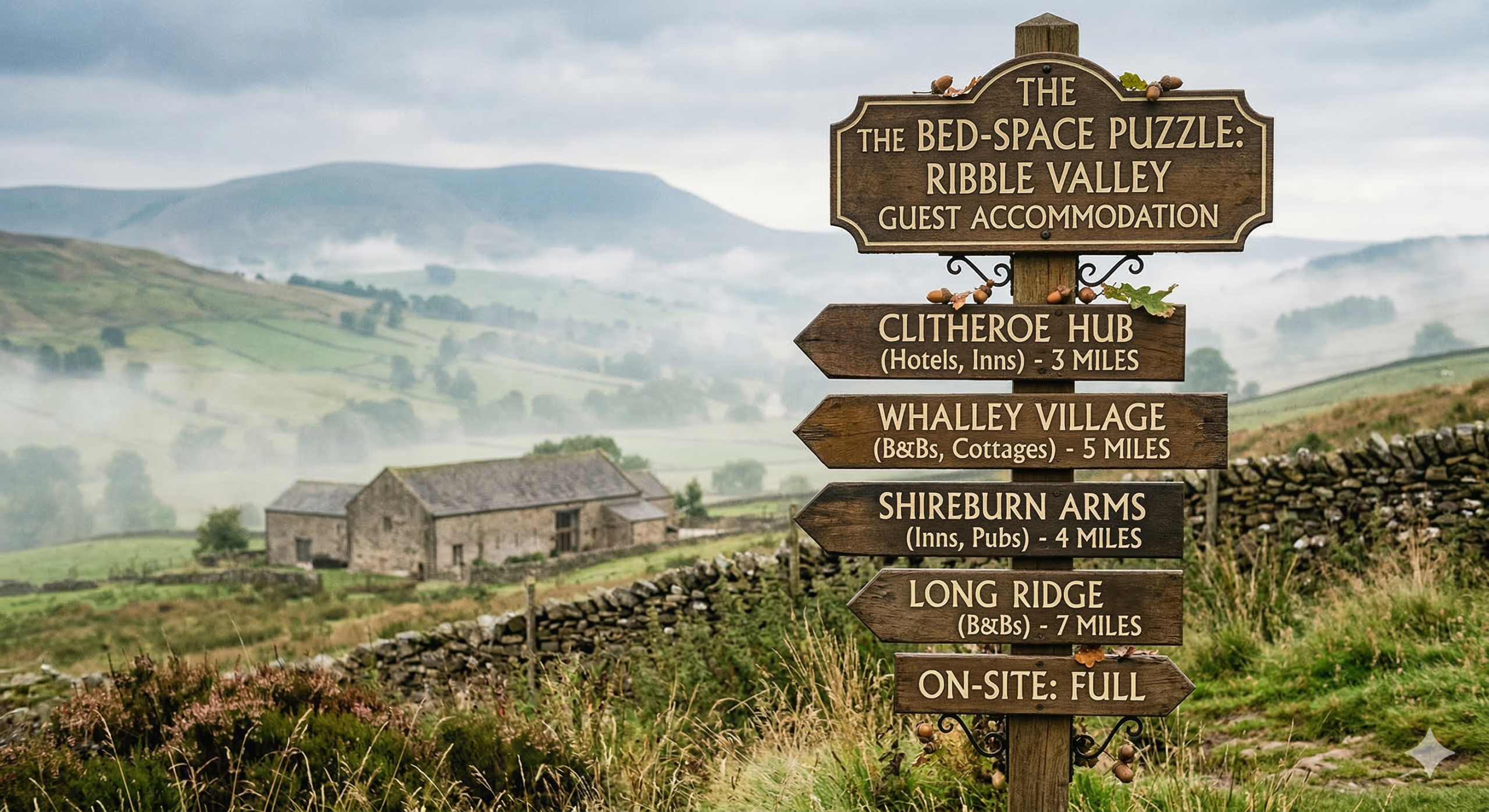
The Ribble Valley is famously a “collection of villages.” While this is central to its charm, it means that guest accommodation is rarely concentrated in one place.
Unlike a city-centre hotel wedding where everyone simply heads to the lift at midnight, a Valley wedding requires a “Hub and Spoke” strategy to ensure no guest is left stranded or frustrated.
1. The “Priority Pod” Strategy
Before you send a single invitation, audit your venue’s capacity. If they only have 12 rooms, those are your “Priority Pod.”
- The Practical Advice: Assign these rooms to the immediate family and bridal party personally before the formal invites go out. This prevents a distant cousin from booking the last on-site room while your parents are left searching for a B&B three miles away.
- The Tangible Detail: If your venue is The Out Barn or Bashall Barn, look for “glamping” or cottage options within close distance first. These are the gold-dust rooms of the Ribble Valley.
2. Identifying Your “Secondary Hubs”
Since your guests will be scattered, you need to create “Secondary Hubs”—groups of accommodation in the same town or village.
- The Logistics: Choose one town (like Clitheroe) or one large village (like Whalley) as your primary recommendation.
- The Benefit: If 40 of your guests all book different B&Bs in Clitheroe, you can hire one 40-seater coach to do a single drop-off point at the end of the night. If guests are scattered randomly toward Longridge, Blackburn, and Burnley, your transport costs will spiral.
3. The “Block Booking” Myth
Many smaller Ribble Valley inns, like the Shireburn Arms are popular with weekend hikers and locals. They rarely “block out” rooms for a wedding they aren’t hosting unless you act early.
- The Strategy: Call local inns 12 months in advance. Ask if they offer a “Wedding Discount Code” for your guests. Even if they won’t hold the rooms without a deposit, having a specific “recommended” inn on your website encourages guests to bunch together.
4. Navigating the “Minimum Stay” Trap
During peak season (May–September), many Ribble Valley B&Bs and luxury rentals (like those near Stonyhurst) enforce a two-night minimum stay.
- The Stress Point: Guests traveling from nearby might only want to stay for the night of the wedding.
- The Solution: Be transparent. In your accommodation guide, explicitly flag which local spots allow one-night stays and which require two. Suggest that guests who have to stay for two nights turn it into a “Ribble Valley Mini-Break” and provide a link to your “Morning-After Brunch” guide.
5. The “Morning-After” Coordination
When guests are spread across the valley, you lose that “breakfast debrief” moment the next morning.
- The Tangible Detail: If your venue can’t host a communal breakfast for everyone, pick a central “Hub” location for a 10:30 AM meetup.
- The Recommendation: Places with large capacities like Holmes Mill in Clitheroe or a large gastropub with plenty of parking are ideal for a casual, “drop-in” post-wedding brunch.
The Accommodation Checklist:
- [ ] The “Room Audit”: Exact number of on-site beds vs. guest list size.
- [ ] The “Hub” Selection: Pick one town (Clitheroe or Whalley) for the majority of guests.
- [ ] The One-Night Filter: Identify local B&Bs that don’t have a two-night minimum.
- [ ] The Transport Link: Ensure your chosen “Hub” is the primary pickup/drop-off point for Beez or your shuttle bus.
The Final Verdict: Centralise to Socialise
The bed-space puzzle isn’t just about where people sleep; it’s about how the group feels the next day.
By encouraging your guests to cluster in one of the Valley’s “hub” towns, you solve the transport headache and the social “drift” simultaneously.
A little bit of early direction from you ensures that while the Valley may be wide, your wedding party stays close together.