The Forest of Bowland, an Area of Outstanding Natural Beauty (AONB) in the Ribble Valley, offers some of the most profound night skies in England.
Far from the orange glow of urban light pollution, this rugged landscape provides a celestial theater for observing the universe.
Whether you are a seasoned astronomer or a casual stargazer, knowing where to go—and how to prepare—is the difference between a cold night in a car park and a breathtaking encounter with the cosmos.
Top 5 Locations for Stargazing
These sites are officially recognized as Dark Sky Discovery Sites (or local favourites) for their minimal light pollution, excellent sightlines, and public accessibility.
1. Gisburn Forest Hub
- The Experience: Located deep within Lancashire’s largest wooded area, this is arguably the “darkest” site. The sense of isolation here is palpable, providing an incredibly immersive, pitch-black environment.
- What to Look For: This is the premier spot for Deep Sky Objects. With a telescope or good binoculars, you can observe the Andromeda Galaxy or the Orion Nebula. The forest “Hub” offers a solid, flat base perfect for setting up photography tripods.
- Practical Detail: Ample parking and a popular venue for organised events. Be prepared for the heavy, profound silence of the deep woods.
2. Slaidburn Village Car Park
- The Experience: Ideal for those who want dark skies without feeling completely isolated. Located at the edge of this historic village, it sits adjacent to the River Hodder.
- What to Look For: Low hedges to the north and east screen the village’s minimal streetlights, offering a clear window to the Northern constellations like Cassiopeia and the Plough (Ursa Major).
- Practical Detail: The most “civilised” site, featuring accessible public toilets. It is a fantastic entry point for families.
3. Beacon Fell Country Park
- The Experience: Situated on the edge of the AONB, the park offers elevated viewpoints. As you emerge from the woodland toward the summit, you gain a 360-degree panorama.
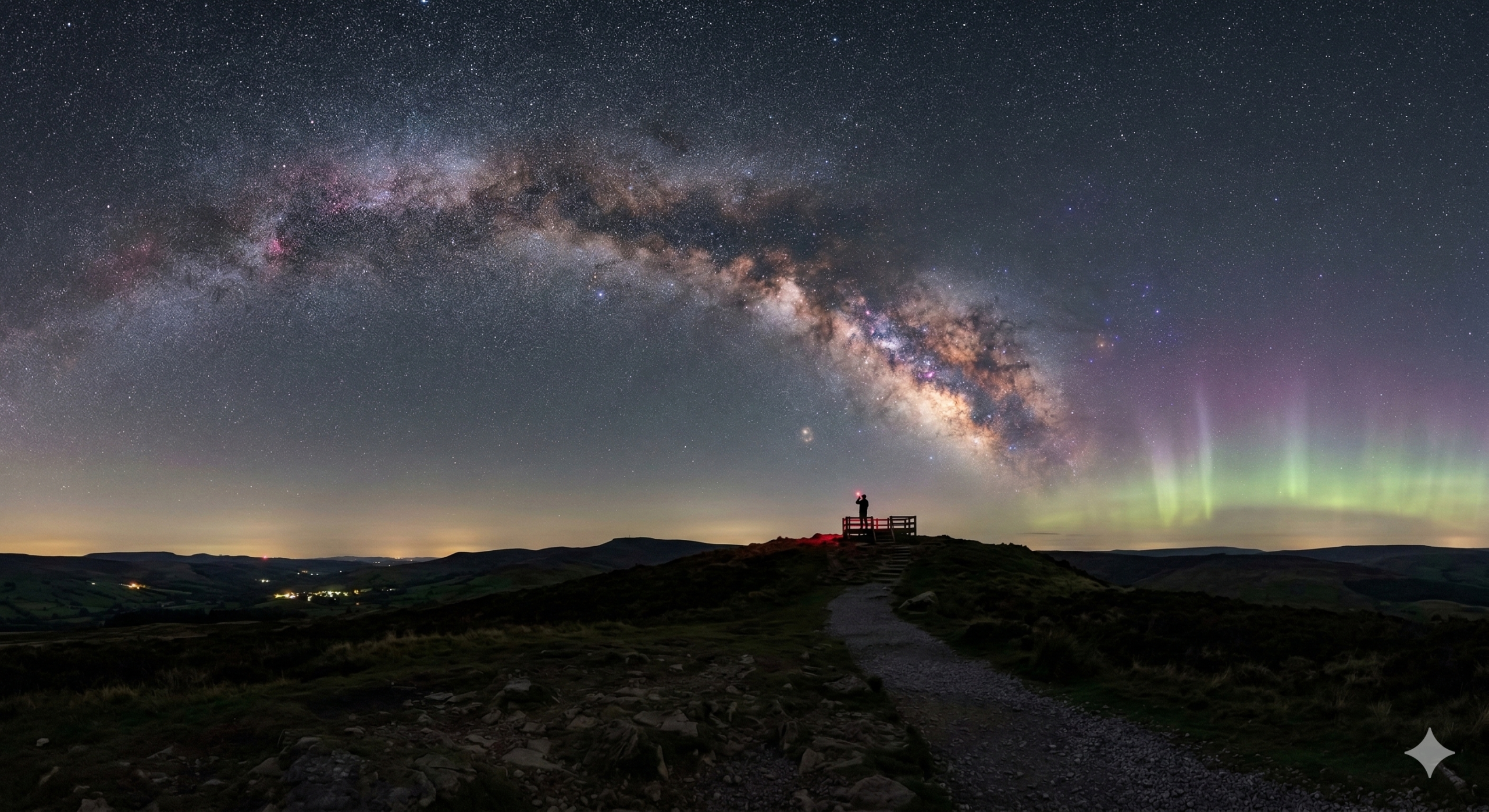
- What to Look For: Exceptional for horizon-to-horizon views. On clear nights, the lack of obstructions makes it a favourite for spotting the Milky Way arching directly overhead.
- Practical Detail: Features a large car park. The walk to the summit is short but can be steep; stick to the main paths to avoid tripping in the dark.
4. Crook o’ Lune Picnic Site
- The Experience: Located at the famous horseshoe bend of the River Lune, this site is easily accessible from Lancaster and the M6.
- What to Look For: The picnic area on the north bank provides wide views toward the Trough of Bowland. It is an excellent spot for viewing Meteor Showers due to the expansive sky.
- Practical Detail: Includes accessible toilets and a large car park. While slightly more semi-rural, the overhead clarity remains superb.
5. Jeffrey Hill (Longridge Fell)
- The Experience: Perched on the western edge of the Ribble Valley, Jeffrey Hill is increasingly famous as the region’s “go-to” spot for the Northern Lights (Aurora Borealis). Its elevated position gives a commanding view over the valley toward the northern horizon.
- What to Look For: Because it faces north with very little intervening light, this is your best chance to capture the aurora during periods of high solar activity. It is also excellent for observing planetary conjunctions.
- Practical Detail: There is a dedicated car park off Forty Acre Lane. The ground can be exceptionally boggy, so staying near the gravel areas or the immediate vicinity of the car park is advised at night.
When to Visit: A Seasonal Guide
For the darkest skies, aim for the “New Moon” period (the window a few days before and after the moon is invisible).
| Season | The Experience | Notable Sights |
| Winter | The Peak Season. Long, dark nights and stable, crisp air. | Orion the Hunter, the Pleiades (Seven Sisters), and the brightest stars. |
| Spring | Warmer but still dark. Known as “Galaxy Season.” | Leo the Lion and the Plough positioned directly overhead. |
| Summer | Short nights; it never gets truly pitch black in June or July. | Perseid Meteor Shower (mid-August) and “night-shining” clouds. |
| Autumn | Dark skies return with more manageable temperatures. | Andromeda Galaxy and the Great Square of Pegasus. |
Preparation and Etiquette
Clothing and Provisions
- The “Layer” Rule: Wear multiple thin layers (thermals, fleece, windproof shell). You will be standing still on cold ground, and the “Bowland Chill” is real.
- Footwear: Thick wool socks and sturdy, waterproof boots are non-negotiable—especially at Jeffrey Hill.
- Warm Drinks: A large thermos of hot chocolate, soup, or tea is essential for maintaining core temperature.
Equipment & Safety
- Red Light Torch: White light ruins your “night vision” (which takes 20 minutes to develop). Use a torch with a red filter to navigate.
- Binoculars: A pair of 10×50 binoculars is often better for beginners than a telescope, as they are easier to point and carry.
- Communication: Phone signal is patchy. Always tell someone your specific location and your expected return time.
Common Sense Behaviour
- Light Discipline: When arriving, turn off your headlights as soon as it is safe. Never shine a white light toward other observers.
- Respect the Land: No overnight camping or campervan stays are permitted at these sites. Take all litter home and stick to recognized paths.
Conclusion
The Forest of Bowland remains one of the few places in the UK where you can truly feel the scale of the universe.
From the deep, silent woods of Gisburn to the aurora-watching heights of Jeffrey Hill, the Ribble Valley offers a sanctuary for those looking to escape the glare of modern life.
By preparing for the elements and respecting the environment, you aren’t just looking at the stars—you’re experiencing one of the last great wildernesses of the night.